Thursday, May 29, 2014

CONDONATION OF DELAY IN FILING APPEAL  - SUBSTANTIAL JUSTICE SHOULD PREVAIL

 "In our view, condoning the delay always advances the cause of justice and afford opportunity to parties to contest their case on merits whereas; declining to condone results in depriving them of an opportunity of hearing on merits. By this expression, we do not mean to suggest that in every case the court should always condone the delay. All that we wish to say is that by and large, the approach of the court should be to ensure that substantial justice is done to parties by affording them an opportunity of hearing on the merits of the case." This was observed recently on 19/05/2014 by a division bench of the Hon'ble Gauhati High Court in Pawan Enterprises' case WP(C) 2476 of 2014.

In the above case, the appeal before tribunal was delayed by  2 months and 19 days and Hon'ble Tribunal rejected the prayer for condonation on the ground that illness of the staff who signed the appeal cannot be a genuine cause for delay. Hon'ble High Court, while relying on the judgment of the Apex Court in "Sangram Singh –vs -Election Tribunal, Kotah and another, AIR 1955 SC 425" held that the delay in filing the appeal before the Tribunal should have been condoned. Since the Tribunal did not do it, we, on our own, condone the delay.
In the said Judgment, the Division bench also held that signing of appeal by should not be basis to dismiss the appeal and the Tribunal could have granted an opportunity to writ petitioners to rectify the defects.
.

Wednesday, July 11, 2012

VAT on Textiles

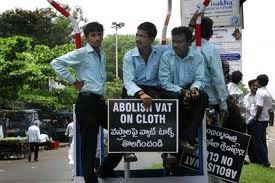
So a day long bandh has been observed by Textile Business Sector in the State of Assam. As per media, the bandh was a grand success. I may be allowed to discuss the back ground of this huge protest.
The Government of Assam has levied tax (VAT)  @ 5% on sales/ purchases of ‘Textiles fabric including textile made-ups i.e. fabric that has undergone  a stitching process’ w.e.f. 28/06/2012 vide  Notification No. FTX.55/2005/Pt-V/255 dated 28th June 2012. The readers may be aware that the textiles has been brought under the ambit of the Assam Entry Tax Act, 2008 and currently 2% Entry tax is leviable on import (bringing from out-side the local area) of textiles. It is worth to be noted that under Entry tax Act, there is no system of adjusting the entry tax on raw materials against the VAT liability of the finished products.
This may be a mystery for the common man that why the textiles fabrics (unstitched) were tax exempted before the said date and what was the reason that the Government of Assam, which do not mind to levy tax on petrol @ 27.5% had not levied any VAT on this commodity. Let me take an attempt to demystify the issue.
The textiles along with some other commodities were subject matter of  “the Additional Duties of Excise (Goods of Special Importance) Act, 1957” (popularly known as AED-GSI) for levying of additional duties of excise. The commodities covered under this AED-GSI are listed in the First Schedule to the Act. The States were entitled for getting their shares against the collection of such duties. However, such entitlement was subject to a restriction that the States which levy a tax on the sale or purchase of these commodities after the 1st April, 1958 shall not participate in the distribution of the net proceeds. It is thus apparent that the additional duty of excise (AED-GSI) was actually in lieu of Sales tax. As per my little knowledge, this may be an important reason for keeping the textiles in Schedule 1 of the Assam Value Added Tax Act, 2003.
The Central Government had however exempted the goods under First Schedule of vide Central Excise Notification dated 01.03.2006. Thus fabric enjoyed exemption from both the excise duty and sales tax. When this exemption was introduced it was widely perceived that the levy of sales tax on fabric was just a matter of time. But that was not to be. While the rate of AED-GSI was reduced to 0%, the taxable items continued to remain to be listed in the said First Schedule. The state governments were thus prevented from levying sales tax on Fabric because this product enjoyed the protection of being listed in the First Schedule to the AED-GSI Act 1957, though the rate of tax was 0%.
The situation changed, when the Central Government vide Finance Bill 2011 had removed the textiles from the First Schedule of the AED-GSI Act 1957. So as soon as Finance Act was passed, the State legislatures were become free to impose sales tax on textiles.
As it has been heard that VAT on textiles have been introduced in some other States also, such as Andhra Pradesh, Maharashtra, Punjab etc. In all the States the Textiles sector has vehemently opposed the imposition of VAT.  It has been heard that Chief Minister of Goa, had announced that his Government is going to remove VAT on fabrics.

Saturday, June 30, 2012

TEXTILES ARE NOW TAXABLE UNDER AVAT ACT, 2003


As per Notification no. FTX.55/2005/Pt-V/255, “textiles fabric including textile made-ups, i.e. fabric that has gone undergone  a stitching process” are made taxable @ 5% w.e.f. 28th June, 2012.
A new entry at Sl. No. 124 has been inserted in Second Schedule (Part- A), which reads as “Textiles fabric including textile made-ups, i.e. fabric that has gone undergone  a stitching process”. 

It will be a new task for the dealers to claim refund of entry tax paid on unsold stock of such goods as on 28/06/2012 (opening).

SUGAR IS NOW NOT SO SWEET

‘SUGAR’ IS NOW NOT A TAX FREE ITEM

As per Notification no. FTX.55/2005/Pt-V/255, Sugar is made taxable @ 5% w.e.f. 28th June, 2012.

Sunday, June 3, 2012

Input tax credit on lease transaction of Vehicles

Clarification dated 22nd March, 2006 bearing distinctive number CTS-16/2005/483 issued from Authority at Kar Bhawan, Guwahati has been brought to my knowledge for academic discussion. The clarification is relating to eligibility of Input Tax Credit on Vehicles which are used for leasing (transfer of right to use). After referring to the provisions of section 14(6)(f) and the seventh schedule of the Act, it has been clarified that Input Tax Credit is not allowable to the dealer on purchase of vehicles even if such vehicles are used by him for leasing (transfer of right to use) business.

The above clarification is mainly based on the ground that ‘Vehicle’ is enumerated in the negative list (seventh schedule) and as per the provisions of section 14(6)(f) I.T.C. is not allowed on purchase of capital goods specified in the Seventh Schedule. The best part of this clarification is that it had not restricted the ITC on other Capital goods purchased for transfer of right to use of goods.

By 46th amendment in the Constitution, clause 29A was inserted in Article 366 and the meaning of the term “tax on the sale or purchase of goods” has been stretched to include tax on few deemed sales in its ambit. At the end of this sub-clause, it has been specified that “and such transfer, delivery or supply of any goods shall be deemed to be a sale of those goods by the person making the transfer, delivery or supply and a purchase of those goods by the person to whom such transfer, delivery or supply is made”.

Thus, the clause 29A, which has empowered the States to levy tax on the transfer of the right to use any goods for any purpose for cash, deferred payment or other valuable consideration also specifies that such transfer or delivery of goods shall be deemed to be a sale of such goods. In the instant case of the transfer of right to use of vehicle, there is a deemed sale of ‘vehicle’. Accordingly for the purpose of taxation under the Assam Value Added Tax Act, 2003, it can be said that when there is a transfer of right to use motor vehicles in a leasing agreement, there is a resale of those vehicles in an unmodified form and thus ITC may be allowed on purchase of such vehicles under section 14(3)(a).

I don’t think it will be reasonable to treat the vehicle as tradable goods for the purpose of levying of taxes and to treat the same as capital goods for the purpose of disallowing the benefit of Input Tax Credit.

Opinions of esteemed readers are awaited on this issue........

Friday, June 1, 2012

Problem in CST registration

In order to get the benefit of concessional rate of tax on inter-State purchases, the class or classes of goods must be specified in the Certificate of Registration issued under the Central Sales Tax Act, 1956.
While issuing registration to dealers, the authorities in Assam rely on an online module for specifying the goods to be imported for different purposes. The registration form provided in the module requires that the registering authority select the class or class of goods from a dropdown list. Now all class or classes of goods cannot possibly be enumerated in a list. So whenever a dealer applies for registering some goods which is not specified in the online dropdown list, it is conveniently entered as “Others”. The worrying part of it is that when the residuary category is selected, no place is provided to specify what that “Others” denote. And so, that class of goods simply find mention in the Registration Certificate as “Others”
To a person examining that registration certificate with an intent to examine what goods are covered under the registration, that ‘Others’ may either denote -
a)      goods applied for in the registration but which do not find mention in the online drop down list; (both lists would not normally be available before him and hence he cannot possibly find out ); or
b)      all such goods which are not enumerated in the online list (which again will not normally be available to the reader); or
c)      any goods whatsoever (which will leave the reader in more than a spot of worry);
Add to it the fact that the online list, not being a statutory one, can change from time to time on the whims and fancies of administrators or programmers, the position of the examiner will indeed be very worrisome.
So if I am an outside dealer selling goods to a Assam Dealer, will I be applying concessional rates of tax if the registration certificate contains the vague term “Others”? If I am well aware of the penal consequences for violation of provisions of section 8, I will definitely play safe and deny concessional tax rate.
I therefore find no reason as to why proper amendments should not be carried out in the online module. An additional box which reads “If Others, Specify” will be more than sufficient. This will ensure that the registration certificate carries the class or classes of goods as per the requirements of the dealer seeking registration and as per the requirements of law.
Your honour, please.........................