Friday, August 15, 2014

THE ASSAM VALUE ADDED TAX (AMENDMENT) BILL, 2014

GIST OF PROPOSALS OF AMENDMENTS IN AVAT (AMENDMENT) BILL, 2014

1. Part –II of the Explanation to clause (44) of section 2 shall be substituted as follows:-
(ii) any amount allowed by seller of goods to the purchaser as cash discount or commission or trade discount at the time of sale of goods subject to the condition that such discount or commission is shown in the original invoice.”

2. Clause (c) of sub-section (1) of section 13 shall be omitted.

3. New sub-section (3) will be inserted in section 13, which will read as:-
(3) Notwithstanding anything contained in this Act, if after issuing invoice, any amount is allowed by a selling dealer to a purchaser as cash discount or commission or trade discount or sales incentive or otherwise and such amount is adjusted through credit note issued by such selling dealer to the purchaser or by any other means, the selling dealer shall not be allowed to reduce his output tax liability on account of such deduction".


concessional rate of entry tax on import of raw materials

कच्चे माल के आयात पर प्रवेश कर हटाने की मांग को नज़रअंदाज़ किया गया, टेक्स रेट में रियायत देने का झुनझुना। 


Different Institutions and trade associations has urged in their pre-budget memorandums to abolish entry tax on the import of raw materials by industries. Unfortunately, this demand was totally overlooked by Hon'ble Minister. However he said- "To promote industrialization in the State, especially MSME sector, I propose to allow concessional rate of entry tax on all raw materials, used by local industries, if such raw materials are not available locally. I will instruct industries Department to draw up a scheme for this purpose".

Thursday, August 7, 2014

VATassam.com:
CONDONATION OF DELAY IN FILING APPEAL  - SUBSTANTIAL JUSTICE SHOULD PREVAIL

 "In our view, condoning the delay always advances the cause of justice and afford opportunity to parties to contest their case on merits whereas; declining to condone results in depriving them of an opportunity of hearing on merits. By this expression, we do not mean to suggest that in every case the court should always condone the delay. All that we wish to say is that by and large, the approach of the court should be to ensure that substantial justice is done to parties by affording them an opportunity of hearing on the merits of the case." This was observed recently on 19/05/2014 by a division bench of the Hon'ble Gauhati High Court in Pawan Enterprises' case WP(C) 2476 of 2014.

In the above case, the appeal before tribunal was delayed by  2 months and 19 days and Hon'ble Tribunal rejected the prayer for condonation on the ground that illness of the staff who signed the appeal cannot be a genuine cause for delay. Hon'ble High Court, while relying on the judgment of the Apex Court in "Sangram Singh –vs -Election Tribunal, Kotah and another, AIR 1955 SC 425" held that the delay in filing the appeal before the Tribunal should have been condoned. Since the Tribunal did not do it, we, on our own, condone the delay.
In the said Judgment, the Division bench also held that signing of appeal by should not be basis to dismiss the appeal and the Tribunal could have granted an opportunity to writ petitioners to rectify the defects.
.

Wednesday, July 11, 2012

VAT on Textiles

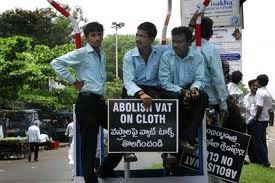
So a day long bandh has been observed by Textile Business Sector in the State of Assam. As per media, the bandh was a grand success. I may be allowed to discuss the back ground of this huge protest.
The Government of Assam has levied tax (VAT)  @ 5% on sales/ purchases of ‘Textiles fabric including textile made-ups i.e. fabric that has undergone  a stitching process’ w.e.f. 28/06/2012 vide  Notification No. FTX.55/2005/Pt-V/255 dated 28th June 2012. The readers may be aware that the textiles has been brought under the ambit of the Assam Entry Tax Act, 2008 and currently 2% Entry tax is leviable on import (bringing from out-side the local area) of textiles. It is worth to be noted that under Entry tax Act, there is no system of adjusting the entry tax on raw materials against the VAT liability of the finished products.
This may be a mystery for the common man that why the textiles fabrics (unstitched) were tax exempted before the said date and what was the reason that the Government of Assam, which do not mind to levy tax on petrol @ 27.5% had not levied any VAT on this commodity. Let me take an attempt to demystify the issue.
The textiles along with some other commodities were subject matter of  “the Additional Duties of Excise (Goods of Special Importance) Act, 1957” (popularly known as AED-GSI) for levying of additional duties of excise. The commodities covered under this AED-GSI are listed in the First Schedule to the Act. The States were entitled for getting their shares against the collection of such duties. However, such entitlement was subject to a restriction that the States which levy a tax on the sale or purchase of these commodities after the 1st April, 1958 shall not participate in the distribution of the net proceeds. It is thus apparent that the additional duty of excise (AED-GSI) was actually in lieu of Sales tax. As per my little knowledge, this may be an important reason for keeping the textiles in Schedule 1 of the Assam Value Added Tax Act, 2003.
The Central Government had however exempted the goods under First Schedule of vide Central Excise Notification dated 01.03.2006. Thus fabric enjoyed exemption from both the excise duty and sales tax. When this exemption was introduced it was widely perceived that the levy of sales tax on fabric was just a matter of time. But that was not to be. While the rate of AED-GSI was reduced to 0%, the taxable items continued to remain to be listed in the said First Schedule. The state governments were thus prevented from levying sales tax on Fabric because this product enjoyed the protection of being listed in the First Schedule to the AED-GSI Act 1957, though the rate of tax was 0%.
The situation changed, when the Central Government vide Finance Bill 2011 had removed the textiles from the First Schedule of the AED-GSI Act 1957. So as soon as Finance Act was passed, the State legislatures were become free to impose sales tax on textiles.
As it has been heard that VAT on textiles have been introduced in some other States also, such as Andhra Pradesh, Maharashtra, Punjab etc. In all the States the Textiles sector has vehemently opposed the imposition of VAT.  It has been heard that Chief Minister of Goa, had announced that his Government is going to remove VAT on fabrics.